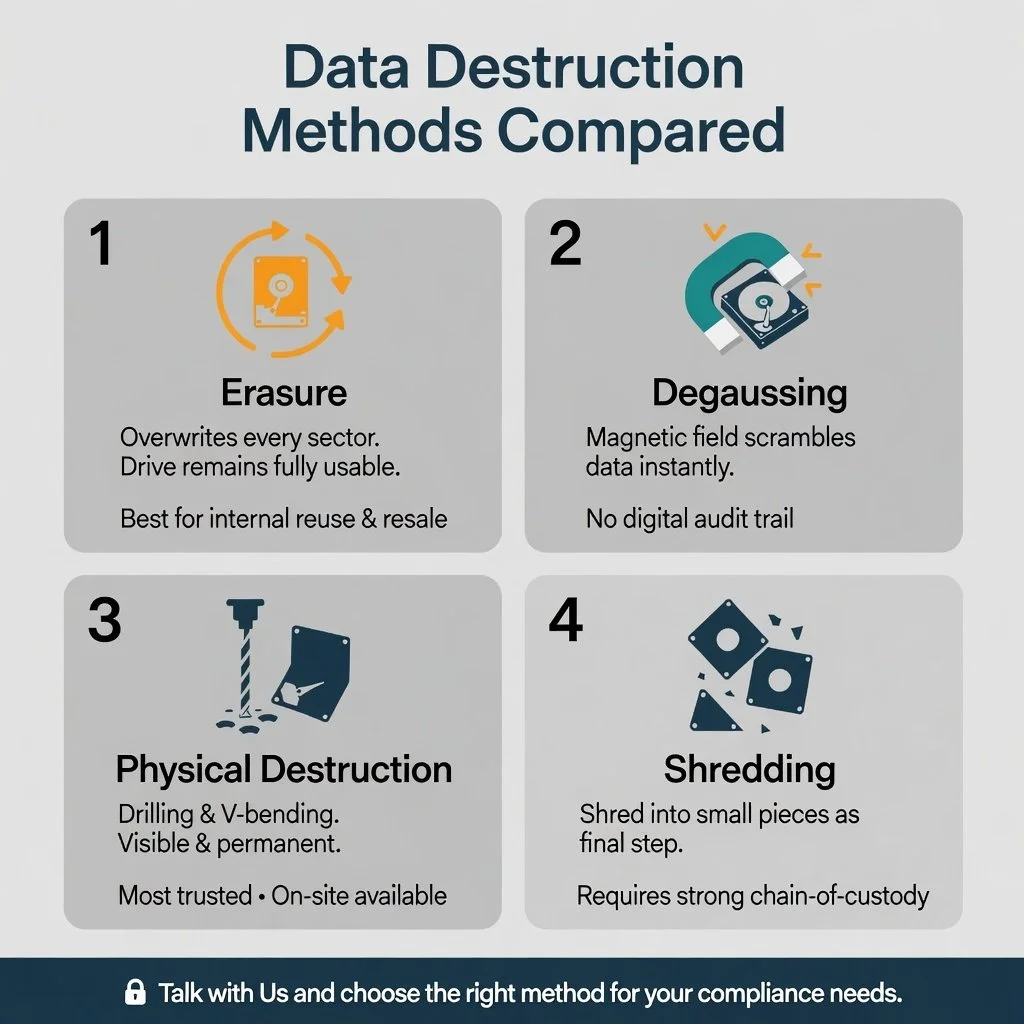
4 ways to destroy data – which one fits your ITAD strategy? 🔐
Hard drives and SSDs leave your building every day. Reused, resold, or recycled – but is the data truly gone?
Not all destruction methods are equal. Some leave drives reusable. Others guarantee compliance but zero reuse.
We’ve broken down the 4 most common ITAD methods into a simple guide:
👉 Environmental impact
👉 Data safety rating
👉 Best use case
1. Erasure – Software overwrites every sector of a storage device with data, making original information unrecoverable while keeping the drive fully usable, complies with the NIST 800-88 standards
• Environmental: ★★★★ (drive can be reused or resold; minimal waste)
• Data safety: ★★★★ (all sectors covered)
Best for internal reuse & resale
2. Degaussing – magnetic field (>10,000 Gauss) instantly scrambles the drive’s magnetic domains, but renders the drive non-reusable.
• Environmental: ★ (non-reusable; only recycling for metals/boards)
• Data safety: ★★★★ (effective, but lacking visual audit proof)
3. Physical Destruction – specialized machine drills four holes and bends the drive, visibly destroying platters and read/write heads, shredded into small pieces as the final step
• Environmental: ★ (non-reusable; only recycling)
• Data safety: ★★★★★ (visible for audit tracking; on-site available)
Most trusted • On-site available
Which method does your organisation rely on? ♻️
Contact Us if you need help on handling all IT Equipment that balances security, sustainability, and cost.