
Device-as-a-Service — More Devices Produced, Better Circularity Delivered?
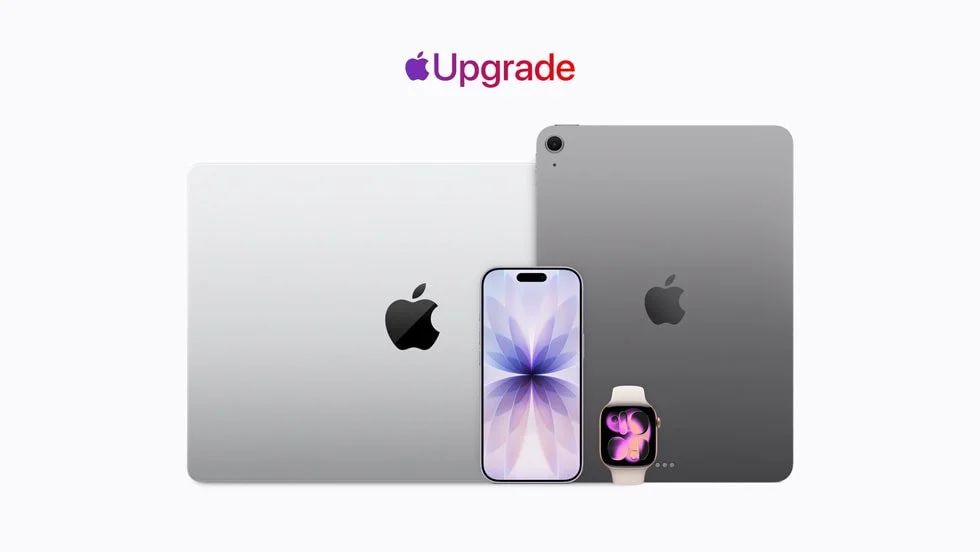
Inspired by Apple’s strategic ‘Apple Upgrade’ programme — a big shift in the consumer hardware model —
we’re seeing the same kind of change already playing out in the enterprise world. In fact, enterprise versions of this model have been around longer and come with more real-world data. So let’s look at an example and dig into what this shift could really mean.
In enterprise IT (computers, copiers and beyond), the shift from upfront Capital Expenditure (CapEx) to a predictable, per-seat monthly Operating Expenditure (OpEx) is already more common. This change redefines endpoint lifecycle management, accelerates hardware refresh cycles, and maximize residual value recovery through circular economy channels.
We’ll look at this from a few angles:
Total production levels (does it create more devices or fewer?)
Circularity of device
What is actually driving market adoption and what is the possible macro outcome.
We picked Dell’s PC-as-a-Service (PCaaS) as case study,
In APAC - more company in Japan, Singapore and New Zealand adopts PCaaS (32–36% market adoption), well above the APAC average of ~20%
Total 68% of organizations among the large enterprises with 1,000+seats adopts
Sector-wise: strongest uptake in financial services, tech, telecommunications and the public sector; started gaining traction in healthcare and education
Hot and Rising demand for AI-capable PCs drive faster growth across APAC (22–35% CAGR)
What Device is covered?
Model covers all range of enterprise device with all tier from fixed/deskbound all-in-ones, Mainstream Enterprise laptop and AI Workstations.
What drives the organization adoption?
Nobody likes change, it takes a ton of time, effort, and money especially for large enterprise – But two reasons to drives this: Financial savings and Regulatory/ESG
For corporate CIO and CFO, shifting to PCaaS model can eliminate a lump-sum capital expenditure and hidden IT operating friction.
Industry reports point to 15–25% net TCO reduction – from cost associated with inventory management, audit and retiring procedure
Efficiency of working capital, more cash to make strategic investments (e.g., cloud migration/R&D/AI investment) while maintaining off-balance-sheet.
Managing Audit trail and inventory management is not easy: An incident happen recently - An ex-Deloitte IT manager from Hong Kong stole 423 laptops over two years and sold them for HK$1.2 million - This can be prevented.
Accounting standards and ESG Scope 3 reporting – Transparency and fulling corporate disclosure on hardware leases on balance sheet, downstream/upstream scope 3 emission and tracking per serial number.
How does it work for company adopting PCaaS, here is the lifecycle workflow/ upgrade process :
Selection & Configuration – hardware profiles and software bundles
Direct Shipment - Minimal internal IT effort required for setup
Continuous Monitoring with support Assist - monitors device health (battery degradation, thermal issues) and automatically dispatches replacement parts before hardware fails.
End-of-Term Refresh cycle - New replacement devices are ordered and dispatched.
Data transfer, Wipe & Secure Return - The old unit is packed in reusable boxes and returned to Dell - followed by certified data sanitization (onsite or at Dell depot) with audit-ready certificates of data destruction.
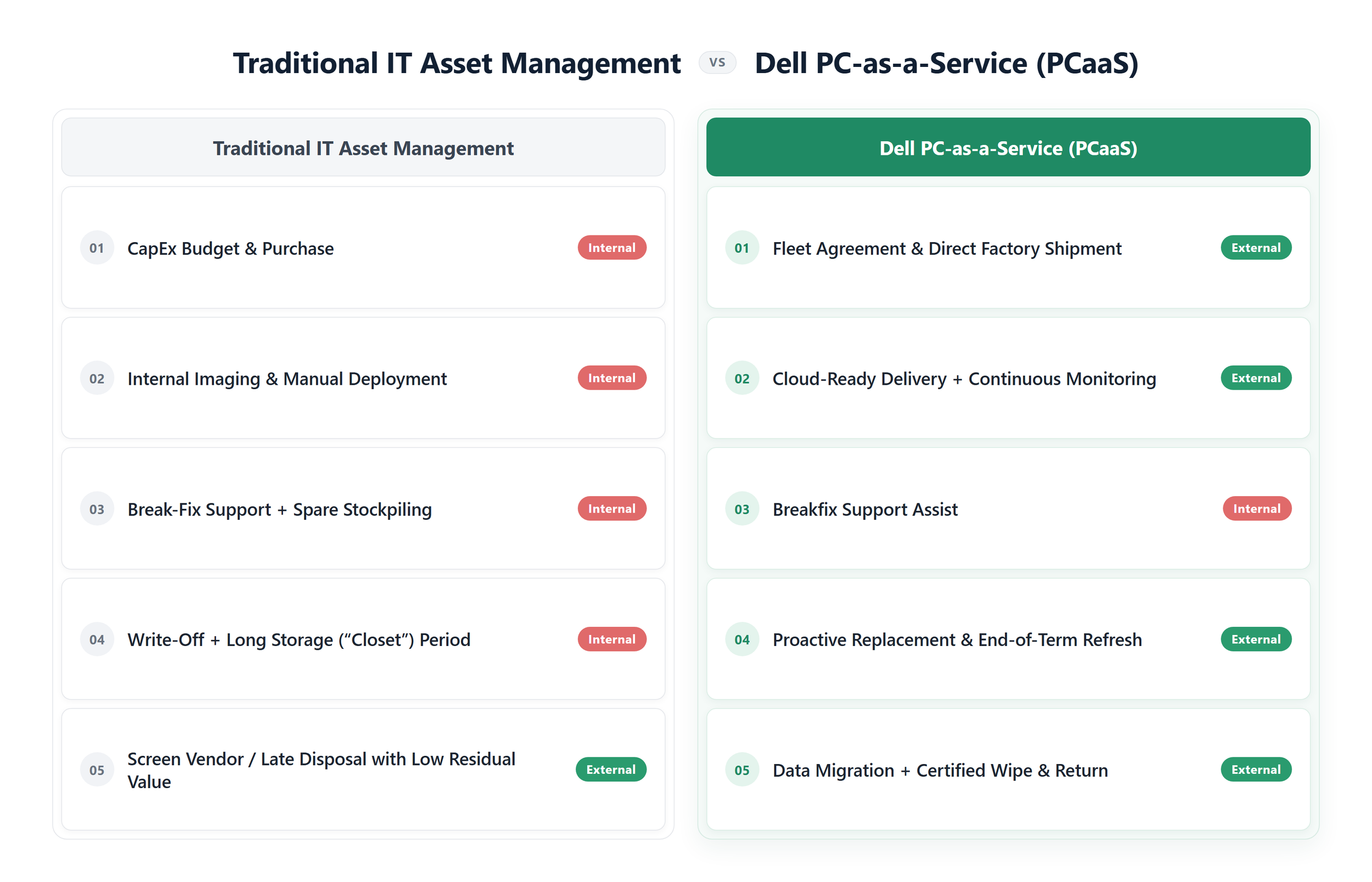
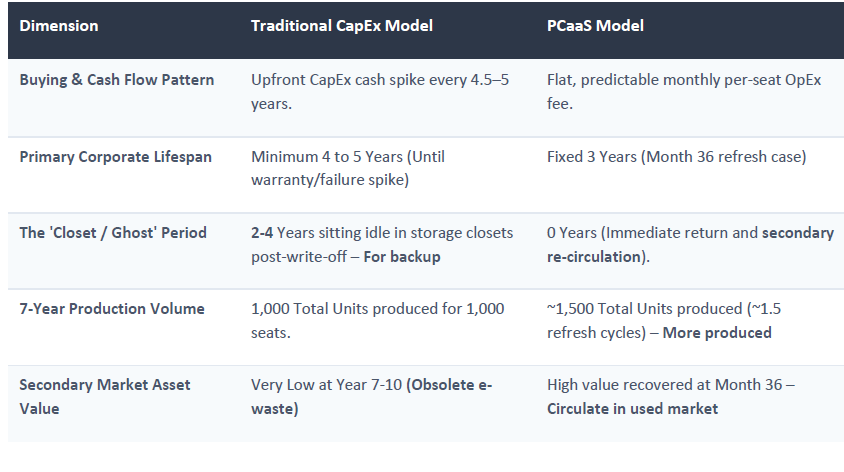
Traditional Buy-own model vs PC-as-a-Service model:
If we model a comparison of 1,000-seat laptop deployment across a 7-year timeline:
Overall Speaking – Does the PC-as-a-Service lead to more production of new device? or did we improve the circularity and become more sustainable ?
The key bottleneck of traditional procurement are -
Old devices sit in storage closets as emergency spares or idle assets.
By the time the company finally liquidates them at year 7-10, battery corrosion, obsolete processors, and erased residual market demand mean their value is virtually $0;
Costly and difficult to refurbish and reuse. Most end up as low-grade e-waste.
PCaaS model creates a more efficient technology distribution ladder:
Shorter Cycle = Higher Volume: Dell produces more brand-new laptops over a 10-year window because corporate primary refresh rates accelerate.
Immediate Re-circulation > Higher Total System Efficiency – Total number of active user years extracted from every single piece of manufactured silicon increases because devices spend zero years sitting idle in closets.
Acceleration AI PC rotation – This is also what enterprise need.
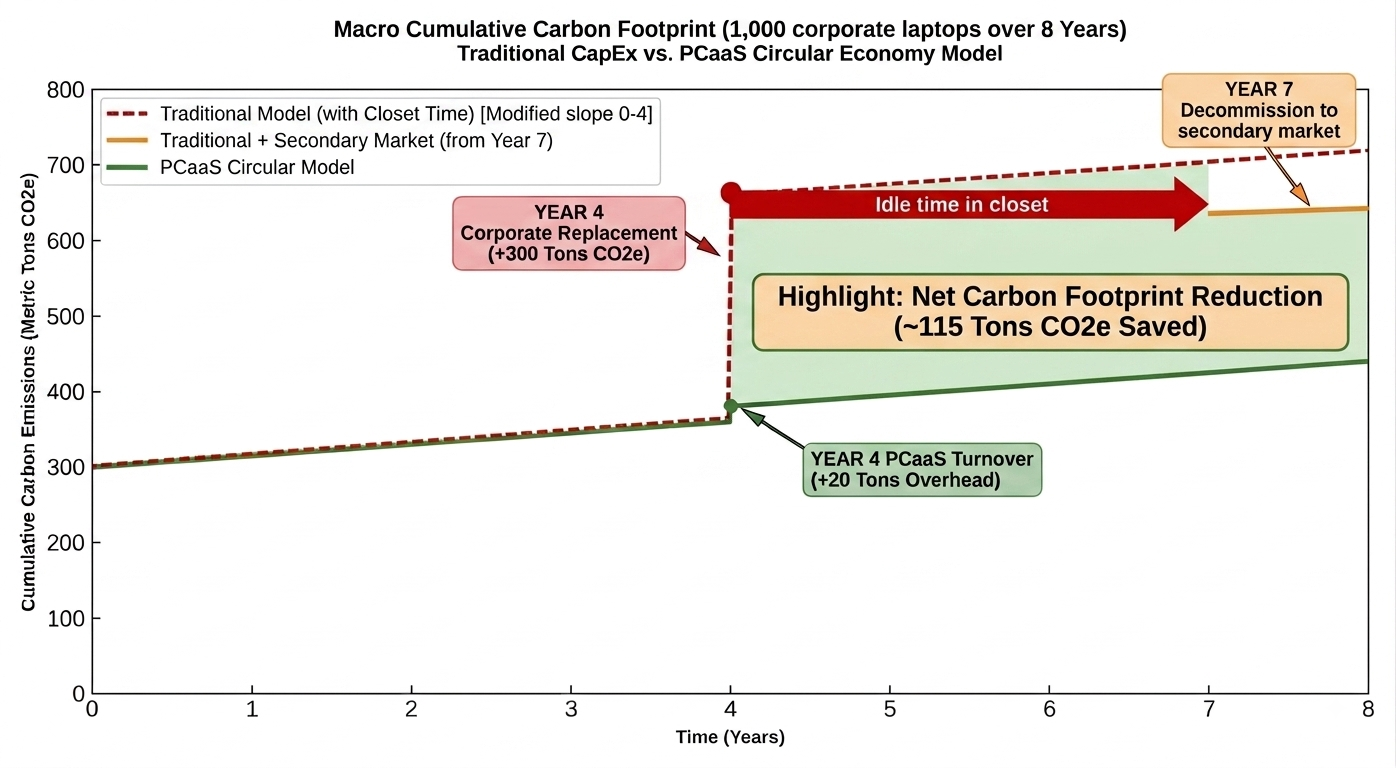
New laptops are produced, but because the old laptops immediately displace new production elsewhere in the economy, the net carbon addition is kept near flat.
To summarize, we could say this is a "Macro Win-Win" at scale in a sense, where:
Corporate Client Win: Gain latest AI hardware, reduce IT support burden, lower TCO, and meet Scope 3 ESG goals.
Manufacturer Win: Higher primary production, recurring subscription revenues, and secondary market margin capture. Opportunity to develop efficient closed-loop supply chain for material harvesting, given all material used are traceable and known in production.
Refurbisher / Secondary Buyer Win - For SMEs, Schools, Developing Nations with budget constraint, they get a quality upgrade and easier access to high-spec enterprise device (with 3-4 years useful life remaining) through Secondary Subscription or Re-leasing provider.
Yet a harder question remains. While developed nations claim circularity compliance, the ultimate end-of-life disposal burden is exported to importing hubs in Southeast Asia, Africa, region that lacks advanced smelting/recycling infrastructure. The risk of "E-Waste Tsunami" Shifting to Developing Economies has not disappeared.