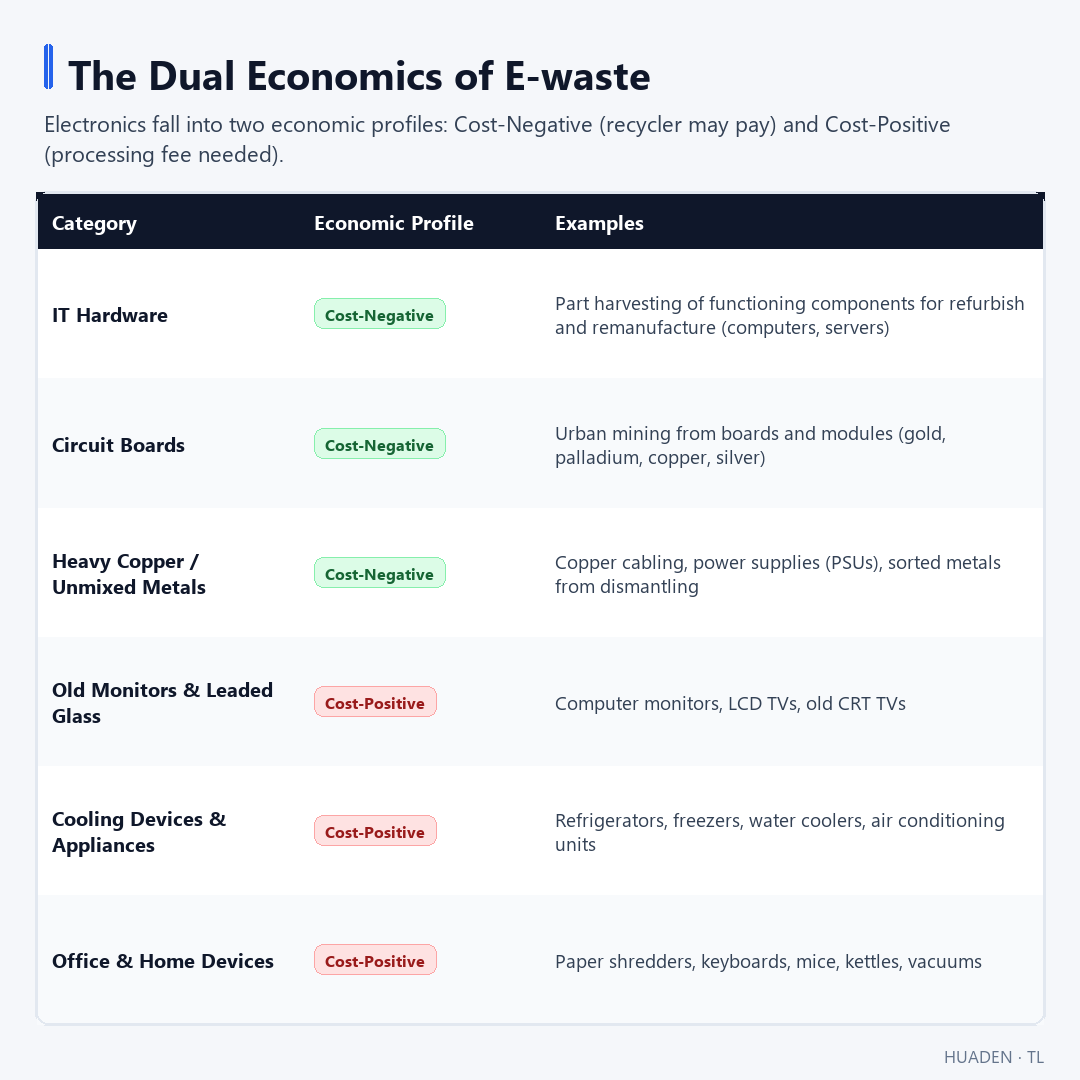
Why your old computer and server pays your bills, but your old monitor and fridge costs you money.
Not all e-waste is created equal. ⚡️
In the recycling industry, electronics splits into two economic realities: Positive Value and Negative Value.
🟢 Value-Positive (Cost-Negative to Recycle):
Devices like telecom servers, high-grade circuit boards, smartphones, and copper cabling contain dense concentrations of gold, silver, palladium, and high-purity copper. The value of recovered metals outweighs the processing cost—recyclers will actually pay you to acquire them.
🔴 Value-Negative (Cost-Positive to Recycle):
Old monitors, CRT, printer, refrigerators, plastic kettles, keyboards and mouses cost far more to process than the materials inside are worth - Recyclers charges to handle them responsibly by labour dismantling and sorting for material recycling.
Why do some electronics cost so much to process?
🛠️ 1. Cost of Labor: Glued batteries, tiny screws, and custom housings mean manual hand-dismantling is required before shredding. Labor hours quickly erode material margin.
☣️ 2. Safe Handling & Decontamination: Extracting mercury lamps, neutralising lithium-ion fire risks, and degassing refrigerant CFCs requires specialized, capital-intensive equipment and safety protocols.
📜 3. Compliance & Disposal Costs: Responsible recycling isn't just about recovering copper—it's about safely disposing of toxic remnants (like batteries, fluorescent Lamps, printed circuit boards etc). Environmental compliance and export controls requires full chain-of-custody tracking, which costs money.
Because e-waste has two economic ends, the right partner must minimize data and environmental risk on the costly side and maximize transparent recovery on the value side — not pretend one flat price does both.
When we pay for recycling, we aren't paying for the trash—we are paying for compliance, worker safety, and pollution prevention. 🌍
#Ewaste #CircularEconomy #Sustainability #ESG #Recycling #UrbanMining #EnvironmentalCompliance