Hot take: Is the semiconductor industry already running more circularly than most people realise?
Hot take: Is the semiconductor industry already running more circularly than most people realise?
While headlines focus on AI hype, new fabs and soaring demand, a quieter circular shift is already underway.
The industry’s shift toward HBM for AI is tightening commodity DRAM/NAND supply — making secondary recovery and reuse more economically sensible, not just “green”
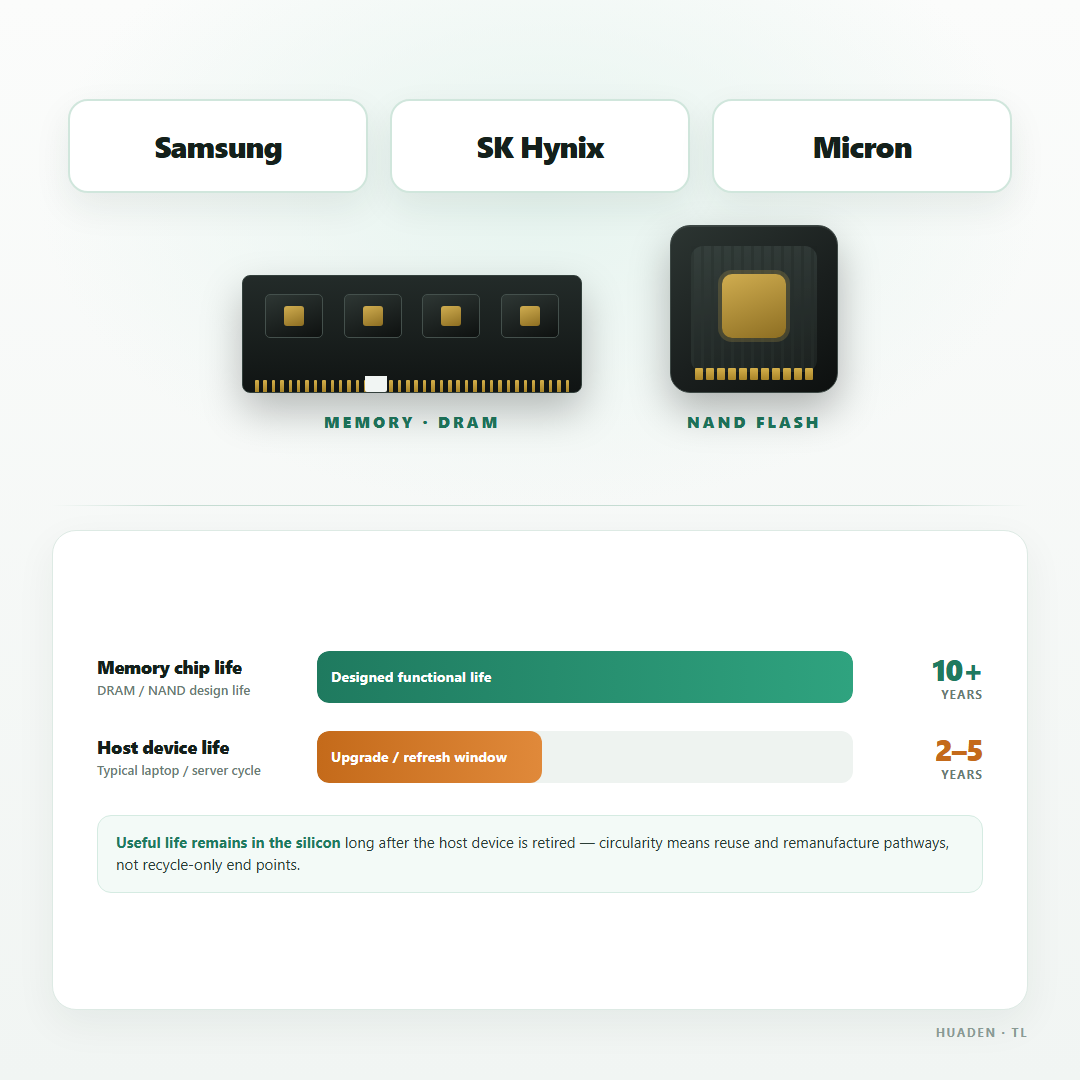
Memory chips (especially Samsung, SK Hynix, Micron DRAM & NAND) are designed for 10+ years of functional life — often several times longer than the typical laptop or server they sit in
High-quality used chips retain strong secondhand and remanufacturing value
Reballing functional dies onto new PCBs avoids the majority of embodied carbon (Manufacturing Chips - Silicon fabrication is the real hotspot; the PCB is secondary)
For large corporates, telecom operators and data-centre-heavy organisations, this could creates a practical dual opportunity: work with the right recovery and manufacturing partners to cut both hardware costs and Scope 3 emissions at the same time.
Supplementary data from recent Semiconductor sustainability reports by Deloitte:
Advanced chips need ~3.5× more energy, 2.3× more water and 2.5× more greenhouse gases — Reuse of existing chips even more valuable
Circularity is one of a core strategies by chip companies (design for repair/reuse, take-back programmes, reverse logistics)
75% of company leaders significantly increased sustainability investments
Green data centres are growing faster (~16% CAGR) than overall data-center market
Customers are willing to pay premium for more sustainable products (12–18% in certain studies; higher in B2B)
The bigger lever is how far manufacturers push green and circular strategy inside that growth:
Premium for more sustainable product, design for repair and reuse, take-back and reverse logistics, and keeping already-fabricated silicon in service longer.
That path can deliver stronger economics and better sustainability outcomes at the same time.
Where are you seeing real semiconductor circularity — not just recycling claims — show up in your supply chain?