A low-carbon computing platform from your retired phones & Build a useful second-life for consumer smartphones
A low-carbon computing platform from your retired phones & Build a useful second-life for consumer smartphones - Interesting case from Google & UCSD.
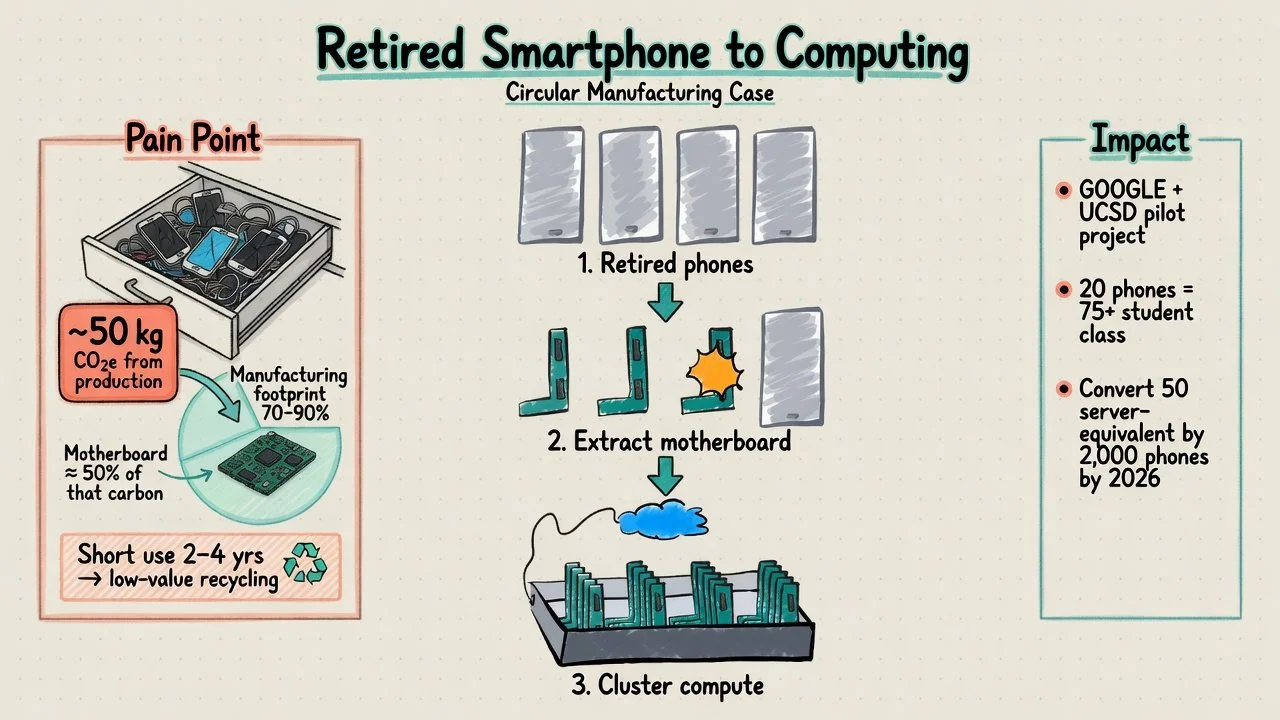
Manufacturing (embodied carbon) typically accounts for 70–90% of a phone’s lifecycle footprint. The motherboard alone carries roughly half of that carbon. When a phone is retired after 2–4 years, the highest-value component is often lost to a drawer or low-value recycling.
Google and UC San Diego are testing a different path: Phone Cluster Computing. They extract motherboards from retired Pixel phones and redeploy them as a low-carbon computing platform.
• 25–50 motherboards ≈ 1 server for suitable workloads (2023 Pixel Fold phone - Core performance match many modern server CPUs)
• Technical path: remove display, battery and chassis for recycling → keep motherboard → switch to general Linux → group the boards into managed computing clusters of 25–50 boards
• Early result: 20-phone cluster already supports a 75+ student class with better latency than default AWS
• Planned scale: 2,000 phones (≈50 server-equivalents) launching at UC San Diego in Fall 2026
This is circular manufacturing in practice.
It is not about giving every student a new flagship phone. It is about recognizing that useful compute life remains long after the consumer upgrade cycle ends. Keeping already-manufactured silicon in service reduces demand for newly manufactured servers and their associated emissions.
The sequence is clear: Secure data destruction → Recover useful components → Redeploy with the right technical approach → deliver low-carbon compute → avoid manufacturing new hardware.
The practical question is whether we keep the silicon working. What do you think — could this model also work for other enterprise devices, and through closer collaboration between practitioners and researchers?
Full article link: https://research.google/blog/a-low-carbon-computing-platform-from-your-retired-phones/